
Ehmet Health Powers Precision in Proton Therapy with XIS Software
We’re proud to share that Ehmet Health played a key role in a study evaluating an image-guided proton therapy system. Our team’s contributions highlight how our technology is helping to advance precision cancer treatment.
In the study:
Ehmet Health was a featured contributor, with our team collaborating alongside leading institutions to implement and test the system.
Our XIS software powered the imaging workflow, controlling kV and cone-beam CT hardware to support accurate, image-guided treatments.
Seamless integration was key, as our software ensured smooth acquisition of imaging data and supported the clinical workflow.
Collaboration at its best, with Ehmet Health’s technology acting as a critical component in a multi-institution effort to improve treatment outcomes.
This recognition underscores our commitment to developing innovative solutions that advance cancer care worldwide. At Ehmet Health, we continue to push the boundaries of precision therapy, helping clinicians deliver safer, more effective treatments for their patients.
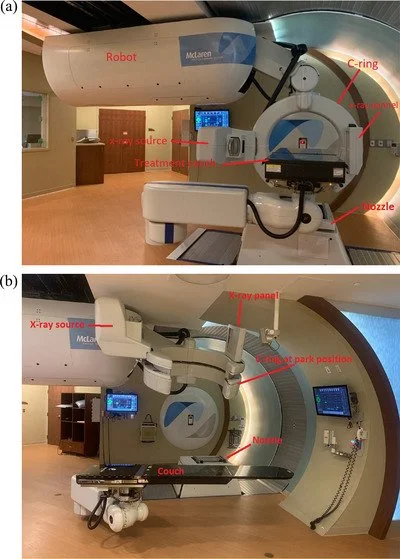
Image description: (a) MPTS treatment room with the imaging system in position for acquisition at couch 0 degrees. The c‐ring is positioned around the couch for image acquisition; the x‐ray panel and the source are on the left and right sides of the c‐ring, respectively . The nozzle is always positioned at the 180‐degree gantry angle during image acquisition. (b) The imaging system with the c‐ring in the park position and the couch in the load position. The x‐ray panel and source are on the left and right sides of the c‐ring, respectively. The nozzle is at 180 degrees. MPTS, McLaren Proton Therapy System.
Verellen, D., et al. "The Implementation of an Image-Guided System at a Proton Therapy Center Facility." Journal of Applied Clinical Medical Physics, vol. 5, no. 4, 2004, pp. 74–86. PubMed Central, https://www.ncbi.nlm.nih.gov/pmc/articles/PMC10930001/
Learn how industry researchers assessed our system in this peer-reviewed publication.
The article details the approach, findings, and relevance to modern treatment standards.